
Insights & Updates
Your got-to source for fresh ideas, news, knowledge
custom web development roi
Filter By

June 22, 2026 Read
Tactile Brutalism & Anti-Soft UI: Why Bold Digital Design is the Future of Brand Identity
For more than a decade, digital design followed a predictable formula—rounded corners, pastel colors, soft gradients, glassmorphism, and interfaces designed to offend no one. While these designs looked polished, they often lacked personality. Today, a new movement is changing the way brands communicate online. The future of web design is bold, tactile, and unapologetically distinctive. What is Tactile Brutalism? Tactile Brutalism combines the boldness of classic Brutalist web design with modern usability. Instead of trying to appear perfectly polished, it embraces: Strong typography High-contrast colors Visible grids Textured elements Sharp layouts Honest visual hierarchy The result is a website that feels real, memorable, and impossible to ignore. Unlike traditional brutalism, today’s tactile approach still prioritizes accessibility, responsiveness, and user experience. The Rise of Anti-Soft UI Soft UI made digital interfaces feel friendly, but over time, many brands began to look identical. Rounded cards. Muted colors. Floating shadows. Generic illustrations. Consumers—especially Gen Z and younger Millennials—are increasingly drawn toward brands with confidence and authenticity. Anti-Soft UI rejects unnecessary decoration and focuses on clarity, bold expression, and personality. Instead of whispering, brands are choosing to speak with confidence. Why This Trend Matters Modern consumers scroll through hundreds of websites every day. The websites they remember are rarely the safest-looking ones. They remember experiences that feel: Distinctive Human Confident Interactive Authentic Your website is no longer just a digital brochure. It is your brand’s first impression. Perfect for Modern Brands Tactile Brutalism works exceptionally well for: Fashion Brands D2C Startups SaaS Platforms Creative Agencies FinTech Companies AI Products Restaurants Lifestyle Brands Health & Wellness Brands When executed correctly, bold design creates stronger emotional engagement while improving brand recall. Does Bold Design Hurt User Experience? Not at all. A common misconception is that Brutalist design sacrifices usability. Professional implementation combines: Fast loading speed Responsive layouts WCAG accessibility Clear navigation Conversion-focused UX SEO-friendly architecture The best designs balance personality with performance. Why Businesses Should Care Consumers trust brands that know who they are. Generic websites create generic impressions. Whether you’re launching a startup, redesigning your corporate website, or building an eCommerce platform, your design should reflect your unique identity—not the latest template. A bold interface tells visitors: “We know exactly who we are.” HIH7’s Approach At HIH7 Webtech Pvt. Ltd., we believe every brand deserves more than a template. Our team creates websites that combine: Modern UI/UX Design Conversion Optimization SEO Best Practices Lightning-Fast Performance Mobile-First Development Brand-Centric Visual Identity Whether it’s React, Next.js, Laravel, WordPress, or custom MERN applications, we design digital experiences that are memorable, scalable, and built for growth. Final Thoughts Tactile Brutalism and Anti-Soft UI aren’t passing design fads. They represent a shift in digital branding—from trying to please everyone to building experiences that connect deeply with the right audience.
1213 Views
June 22, 2026 Read
Tactile Brutalism & Anti-Soft UI: Why Bold Digital Design is the Future of Brand Identity
For more than a decade, digital design followed a predictable formula—rounded corners, pastel colors, soft gradients, glassmorphism, and interfaces designed to offend no one. While these designs looked polished, they often lacked personality. Today, a new movement is changing the way brands communicate online. The future of web design is bold, tactile, and unapologetically distinctive. What is Tactile Brutalism? Tactile Brutalism combines the boldness of classic Brutalist web design with modern usability. Instead of trying to appear perfectly polished, it embraces: Strong typography High-contrast colors Visible grids Textured elements Sharp layouts Honest visual hierarchy The result is a website that feels real, memorable, and impossible to ignore. Unlike traditional brutalism, today’s tactile approach still prioritizes accessibility, responsiveness, and user experience. The Rise of Anti-Soft UI Soft UI made digital interfaces feel friendly, but over time, many brands began to look identical. Rounded cards. Muted colors. Floating shadows. Generic illustrations. Consumers—especially Gen Z and younger Millennials—are increasingly drawn toward brands with confidence and authenticity. Anti-Soft UI rejects unnecessary decoration and focuses on clarity, bold expression, and personality. Instead of whispering, brands are choosing to speak with confidence. Why This Trend Matters Modern consumers scroll through hundreds of websites every day. The websites they remember are rarely the safest-looking ones. They remember experiences that feel: Distinctive Human Confident Interactive Authentic Your website is no longer just a digital brochure. It is your brand’s first impression. Perfect for Modern Brands Tactile Brutalism works exceptionally well for: Fashion Brands D2C Startups SaaS Platforms Creative Agencies FinTech Companies AI Products Restaurants Lifestyle Brands Health & Wellness Brands When executed correctly, bold design creates stronger emotional engagement while improving brand recall. Does Bold Design Hurt User Experience? Not at all. A common misconception is that Brutalist design sacrifices usability. Professional implementation combines: Fast loading speed Responsive layouts WCAG accessibility Clear navigation Conversion-focused UX SEO-friendly architecture The best designs balance personality with performance. Why Businesses Should Care Consumers trust brands that know who they are. Generic websites create generic impressions. Whether you’re launching a startup, redesigning your corporate website, or building an eCommerce platform, your design should reflect your unique identity—not the latest template. A bold interface tells visitors: “We know exactly who we are.” HIH7’s Approach At HIH7 Webtech Pvt. Ltd., we believe every brand deserves more than a template. Our team creates websites that combine: Modern UI/UX Design Conversion Optimization SEO Best Practices Lightning-Fast Performance Mobile-First Development Brand-Centric Visual Identity Whether it’s React, Next.js, Laravel, WordPress, or custom MERN applications, we design digital experiences that are memorable, scalable, and built for growth. Final Thoughts Tactile Brutalism and Anti-Soft UI aren’t passing design fads. They represent a shift in digital branding—from trying to please everyone to building experiences that connect deeply with the right audience.
1213 Views
September 22, 2025 Read
The Ultimate Showdown: Node.js vs PHP for Web Developers
Node.js vs PHP is a key decision for your next web project. This guide helps developers, startup founders, and tech leads select the most suitable backend technology for their specific needs. Node.js and PHP each power millions of websites, but they work differently. Node.js utilises JavaScript on the server and handles tasks as they arrive, while PHP has been a popular choice for building traditional websites for many years. This article covers how Node.js and PHP compare in performance, development speed, scalability, and community support so that you can make an informed choice for your project. Server Response Times Under Heavy Load As your app attracts more visitors, the differences between Node.js and PHP become more apparent. Node.js handles a large number of users simultaneously because it does not get stuck waiting for one task to finish before starting another. PHP handles each request one after the other, while Node.js can handle many at the same time without waiting for tasks like database or file actions to finish. During busy periods, Node.js apps typically respond in under 100 milliseconds, even with thousands of users. PHP apps, especially when using Apache, might take 500 milliseconds or more to respond. Node.js avoids slowdowns by handling tasks in a loop, whereas PHP’s approach can sometimes cause delays. Memory Usage and Resource Efficiency Node.js typically uses memory more efficiently than PHP, but this depends on the specific situation. A typical Node.js app uses about 10-50 MB of memory. Each PHP process uses 5-20 MB, but because PHP starts a new process for every request, the total memory use can add up quickly. Node.js is more efficient because it shares memory across all requests, whereas PHP allocates separate memory space for each request. Concurrent Request Handling Capabilities Due to their construction, Node.js and PHP handle large numbers of requests in distinct ways. Node.js can handle over 10,000 connections at once using very little computer power. This makes it great for things like chat apps or live updates. PHP starts a new task for every request. Most PHP setups can handle 150-300 requests simultaneously before they begin to slow down. The good thing is, if one request has a problem, it does not affect the others. Real-World Benchmark Results Independent benchmarks consistently show Node.js outperforming PHP in specific scenarios: Metric Node.js PHP 8.2 (Apache) PHP 8.2 (Nginx + FPM) Requests/second 15,000-25,000 1,500-3,000 3,000-6,000 CPU usage (%) 45-60 80-95 60-80 Memory per request 0.02MB 8-15MB 4-8MB Results depend on the complexity of your app. Node.js works well for simple JSON APIs, while PHP can be better for CPU-heavy tasks. For example, PayPal switched to Node.js and saw a 35% faster response time and used 65% fewer resources than before. When LinkedIn migrated its mobile app API from Ruby to Node.js, it reduced the number of servers from 30 to 3 and handled twice the traffic. These examples demonstrate that Node.js is well-suited for I/O-heavy applications, but PHP still performs well for traditional websites when optimised. Development Speed and Ease of Use Learning Curve for New Developers PHP typically offers a gentler introduction for newcomers to web development. The syntax closely resembles natural language patterns, making it intuitive for beginners to grasp basic concepts quickly. Variables use simple dollar signs ($), and the language forgives many common mistakes that would break other programming environments. Node.js can be harder to learn at first because you need to understand how JavaScript handles tasks that happen at different times. Beginners might find things like callbacks, promises, and how Node.js manages tasks confusing. But if you already know JavaScript from building websites, Node.js will seem more familiar. The documentation quality differs significantly between the two. PHP’s documentation stands as one of the most comprehensive and beginner-friendly resources in programming, with practical examples for nearly every function. Node.js documentation, while improving, often assumes more technical background knowledge. Code Readability and Maintenance. PHP lets developers write simple, step-by-step code that is easy to follow. Tools like Laravel help keep code neat and easy to manage. Because PHP is clear, the code is easy to read and share with your team. JavaScript can also create concise and efficient solutions when used effectively. Aspect PHP Node.js Variable Declaration $variable = “value”; const variable = “value”; Function Syntax function getName() { } function getName() { } or () => { } Error Handling Try-catch blocks Promises/async-await Code Organization Classes/namespaces Modules/packages Available Development Tools and IDEs PHP developers have access to mature tools. PHPStorm is a top IDE with strong debugging and database features. Free editors like Visual Studio Code also support PHP well. Tools like Xdebug aid in debugging, and Composer facilitates easy dependency management. Node.js also has many tools because it is built on JavaScript. NPM has over a million add-ons, which can be overwhelming for beginners. Tools like Nodemon restart your app while you work, and ESLint helps you write tidy code. Both platforms integrate well with version control systems and continuous integration pipelines. PHP’s XAMPP and Node.js’s local development servers make getting started straightforward, though Node.js often requires more configuration for complex applications. Debugging is different for each. PHP’s step-through debugging is familiar to many developers. Node.js often uses console logs and browser tools, which can make backend work feel less straightforward. Community SupDebugging works differently for each. Many developers are accustomed to PHP’s step-by-step code checking process. Node.js often uses print statements and browser tools, which can make fixing problems on the server feel less simple. The npm ecosystem makes installing, updating, and managing dependencies incredibly straightforward with simple commands, such as npm install. Package.json files provide clear dependency management, making project setup seamless across different environments. PHP relies on Composer, which revolutionised PHP dependency management when it launched in 2012. While Composer is excellent and handles autoloading beautifully, it has around 350,000 packages, which is significantly fewer than npm. However, PHP also benefits from PEAR (though largely deprecated) and direct integration with system package managers. Feature Node.js (npm) PHP (Composer) Total Packages 2+ million ~350,000 Weekly Downloads 70+ billion 6+ billion Package Discovery Excellent search Good search tools Version Management Semantic versioning Semantic versioning Security Scanning Built-in audit Third-party tools Third-Party Library Availability Node.js offers a wide range of libraries. There are many options for web frameworks, data processing, real-time features, and APIs. The fast-growing JavaScript ecosystem means that new libraries appear frequently, which can make choosing the right one challenging. PHP’s libraries have grown and improved over many years. Frameworks like Laravel, Symfony, and CodeIgniter each have strong ecosystems. PHP is especially well-suited for web-focused libraries, such as content management and e-commerce. Although there may be fewer packages, they are often of high quality and stable. The JavaScript ecosystem tends to favour smaller, focused modules following the Unix philosophy, while PHP libraries often provide more comprehensive solutions out of the box. Community Size and Active Contributors Node.js has a very active community with millions of developers. Over 100,000 people contribute to improving Node.js projects on GitHub. The community is younger and likes to try new things, which leads to quick changes but sometimes less stable long-term Support. The community is vast and well-established. PHP has a large, well-established community with over 5 million developers. The community values stability and backwards compatibility, so there are fewer breaking changes and upgrades are more predictable. Communities are highly engaged: Node.js questions: 400,000+ PHP questions: 1.4 million+ Documentation for Node.js is detailed and up-to-date, with good examples and clear instructions. There are also numerous tutorials and community resources available. However, because things change quickly, the guides can sometimes miss new features. Fall behind new features. PHP documentation stands as one of the best in programming languages. The official PHP manual is among the best resources available. The official manual features numerous user examples and comments, making it a valuable shared resource. Its long history means there’s plenty of help for older features and codebases.y Across versions gives it a slight edge for enterprise environments where stability matters most. Scalability and Architecture Benefits Horizontal Scaling Capabilities. Node.js excels at handling thousands of users simultaneously. Its design allows it to manage many connections without consuming excessive resources. You can run several Node.js apps on different servers, and they work well together. Its way of handling tasks helps each server deal with more requests than older methods. PHP used to have trouble scaling because each request required its own task. Newer tools, such as Laravel and Symfony, have improved this process. Tools like PHP-FPM and opcache help share the work. Still, making PHP handle more users often means making one server stronger, rather than spreading the work across many smaller servers. re Support Node.js works well for building small, focused applications that each perform a single task. NPM has many add-ons that enable these apps to communicate with each other and manage messages. Node.js apps also work well with Docker, as they start quickly and use minimal resources. It is easy to build small, separate services with Node.js. You can set up different apps for tasks such as user logins, payments, and analytics, and have them communicate with each other using simple web connections or tools like Redis and RabbitMQ. PHP was not initially designed for this style. Tools like Slim or Lumen help make small web services, but you may find it harder to use PHP for this compared to Node.js. Database Integration Options Both Node.js and PHP can easily connect to databases, but they do so in different ways. Node.js works exceptionally well with NoSQL databases, such as MongoDB, utilising tools like Mongoose that are easy for JavaScript developers to use and integrate. It also works well with databases like PostgreSQL and MySQL, utilising tools such as Sequelize or Prisma. Because Node.js can handle multiple tasks concurrently, communicating with the database does not interrupt other requests. Your app can work with the database and assist users simultaneously. PHP has strong and reliable database support that has been improved over many years. PDO gives a simple way to connect to different databases, and tools like Eloquent or Doctrine help with complex searches. Since PHP handles one thing at a time, database calls are simple and easy to predict. Here’s what each platform handles best: Node.js excels with: Real-time applications needing constant database updates JSON-heavy data structures Event-driven database operations Connection pooling for high-traffic scenarios PHP works great for: Complex relational data operations Traditional CRUD applications Established enterprise database systems Applications requiring ACID compliance Industry Adoption and Job Market Enterprise Usage Patterns Large corporations and startups show distinct preferences when choosing between Node.js and PHP for their backend infrastructure. PHP dominates the content management and e-commerce sectors, with major platforms such as WordPress, Drupal, and Magento powering millions of websites worldwide. Traditional enterprises often favour PHP for web applications due to its mature hosting ecosystem and straightforward deployment processes. Node.js has become popular among companies building real-time applications, small connected services, and platforms that utilise numerous APIs. Banks, streaming services, and social media companies often choose Node.js because it works well with JavaScript and handles multiple tasks concurrently. It is also popular among companies that utilise modern methods for building and running software in the cloud. Large companies often use PHP for their large, single websites and content-focused sites. At the same time, Node.js is more commonly used for distributed systems and modern web applications that require handling a large number of users simultaneously. Many large companies utilise both PHP for their primary websites and Node.js for backend services and real-time features. Salary Expectations and Career Opportunities The job market exhibits varying compensation patterns for PHP and Node.js developers across different experience levels and geographic regions. Entry-level PHP developers typically earn between $45,000 and $65,000 annually in the United States, while Node.js developers command $55,000 to $75,000 for similar experience levels. Mid-level developers observe more pronounced differences, with PHP professionals earning $65,000 to $90,000 compared to Node.js developers, who often receive $80,000 to $110,000. Senior-level positions show the widest gap, where experienced PHP developers earn $90,000-$130,000, while senior Node.js developers frequently command $120,000-$160,000. Career growth varies significantly across different technologies. PHP developers often advance their careers by working at agencies, freelancing, or specialising in content management. Node.js developers typically advance their careers by working at startups, taking on full-stack roles, or collaborating with cloud systems. Because JavaScript is used for both mobile apps and desktop programs, Node.js developers have more career options. Geographic variations impact both technologies, with major tech hubs such as San Francisco, New York, and Seattle offering premium compensation for both skill sets. However, Node.js consistently commands higher average salaries across most markets. Popular Companies Using Each Technology Major technology companies demonstrate clear preferences based on their specific needs and architectural requirements. PHP powers some of the world’s largest platforms, including Facebook’s initial platform (though they’ve developed their own PHP variant called Hack), Wikipedia, WordPress.com, and Slack’s web interface. E-commerce giants like Etsy and Tumblr built their foundations on PHP, leveraging its rapid development capabilities and extensive web-focused libraries. Node.js has become the backbone for numerous high-profile companies requiring real-time functionality and scalable architectures. Netflix uses Node.js extensively for its user interface and API orchestration, while LinkedIn adopted it for mobile backend services. PayPal migrated several applications from Java to Node.js, reporting significant performance improvements and development efficiency gains. Streaming and media companies favour Node.js for its real-time capabilities. Spotify utilises Node.js for various backend services, while WhatsApp (now owned by Meta) built their messaging infrastructure using technologies compatible with Node.js’s event-driven model. Uber relies heavily on Node.js for their real-time matching and tracking systems. Traditional media and publishing companies often opt for PHP for their content management needs. The New York Times, BBC, and numerous news organisations use PHP-based systems for content delivery and management. Meanwhile, modern digital-first companies like Medium and Trello leverage Node.js for their interactive, real-time user experiences. Future Market Trends and Demand The job market trajectory shows diverging paths for PHP and Node.js professionals over the next five years. PHP demand remains steady but concentrated in specific sectors, particularly content management, e-commerce, and traditional web development. The language’s evolution, with PHP 8+ features and performance improvements, maintains its relevance, although growth rates appear more modest compared to newer technologies. Demand for Node.js keeps growing quickly. More companies are utilising small, connected services, serverless setups, and real-time applications, which means they require more Node.js experts. Node.js also aligns well with modern approaches to building and running software, making it likely to continue growing in the future. Emerging trends influence both technologies differently. The rise of headless CMS solutions creates opportunities for PHP developers to work with modern frontend frameworks, while Node.js developers benefit from the growing API economy and IoT development requirements. The integration of artificial intelligence and machine learning yields mixed results, with Python dominating AI development while creating opportunities for Node.js in AI-powered web applications. Remote work trends favour both technologies, but with different implications. PHP’s lower barrier to entry makes it attractive for global distributed teams, while Node.js’s alignment with modern development stacks appeals to companies building remote-first engineering cultures. The contractor and freelance markets show sustained demand for both skill sets, though project types and compensation levels differ significantly between the two technologies. Cost Considerations for Businesses Hosting and Infrastructure Expenses The hosting landscape for Node.js and PHP presents distinct cost profiles that can significantly impact your budget. PHP enjoys a significant advantage due to its widespread shared hosting support, where reliable hosting plans can be found starting at $3-$ 5 per month. Most traditional web hosting providers offer PHP out of the box, making it incredibly accessible for small to medium projects. Hosting Node.js applications typically requires more specialised servers. You often need a VPS or your own server, which can cost $20 to $100 or more each month. Cloud services like AWS, Google Cloud, or DigitalOcean offer more options but require more technical expertise to optimise savings. Still, Node.js apps can utilise resources more efficiently when you have a large number of visitors, which may lower costs as your site grows. Hosting Type PHP Cost Range Node.js Cost Range Shared Hosting $3-15/month Not typically available VPS $10-50/month $20-100/month Cloud Hosting $15-200/month $25-300/month Enterprise $500+/month $800+/month Development Team Hiring Costs PHP developers are generally more abundant and cost-effective to hire. The vast pool of PHP talent means you can find developers at various skill levels and price points. Junior PHP developers might command $40-60k annually in the US market, while senior developers range from $70-120k. Node.js developers often earn higher salaries because they are in high demand and possess specialised skills. Junior Node.js developers usually start at $50-70k, while senior developers can make $80-140k or more. Because JavaScript changes rapidly, Node.js developers often stay up-to-date with the latest software development techniques and can work on both the frontend and backend. Geographic location plays a crucial role in these costs. Eastern European or Southeast Asian developers offer significant savings while maintaining quality, with PHP developers available at $20-$40 per hour and Node.js developers at $25-$50 per hour. Long-term Maintenance Requirements PHP applications often require more frequent security updates and patches, especially when using popular frameworks like WordPress or older versions of PHP. The language’s evolution means that legacy code may require regular updates to maintain security and performance standards. However, the simplicity of PHP deployments means maintenance tasks are often straightforward. Node.js apps have different maintenance issues. Because things change quickly, you need to update add-ons often and pay close attention so updates do not break your app. Security issues in the npm system can affect multiple add-ons simultaneously, so it’s essential to monitor for problems regularly. The maintenance cost difference often balances out over time. PHP may require more frequent minor updates, whereas Node.js necessitates more strategic architectural decisions to manage ecosystem changes. Teams familiar with either technology can manage these requirements effectively, making the choice more about expertise than inherent maintenance costs. Conclusion Choosing between Node.js and PHP isn’t a one-size-fits-all decision. PHP shines with its simplicity, massive community, and budget-friendly hosting options, making it an ideal choice for traditional web applications and businesses seeking to manage their expenses effectively. Node.js takes the lead when you need lightning-fast performance, real-time features, or want to use JavaScript across your entire tech stack. The job market favours both technologies; however, your specific project needs should ultimately drive the decision. If you’re building a content-heavy website or working with a limited budget, PHP’s proven track record and affordable hosting make it a compelling choice. For modern web applications that require handling a large number of concurrent users or real-time data, Node.js provides the performance edge you’re looking for. Consider your team’s expertise, project requirements, and long-term goals – both technologies have their place in today’s development landscape.
1391 Views
August 22, 2025 Read
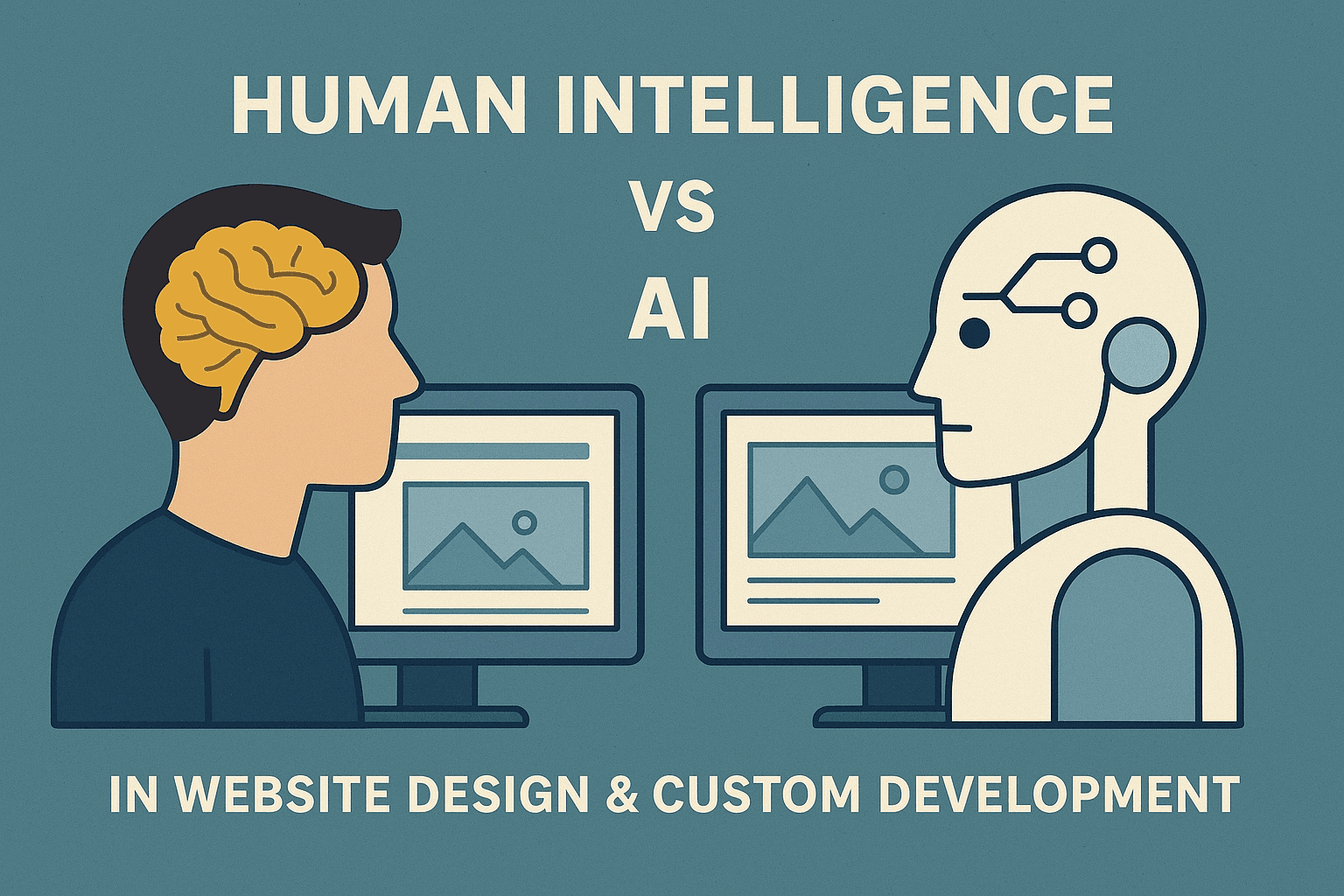
Human Intelligence vs AI in Website Design and Custom Development
As artificial intelligence continues to reshape industries, one question looms large for businesses and developers alike: How much should we rely on AI in website design and custom development, and where does human intelligence still shine? “AI speeds up what’s repeatable, but when creativity or critical thinking is needed, the human brain still takes the lead.” AI excels in automating repetitive, rule-based tasks, much like in manufacturing, where machines speed up production without needing creative input. In web development, AI tools streamline layout generation, testing, content suggestions, and performance optimisation. However, when a critical decision needs to be made, such as resolving a unique user journey issue or aligning a design with nuanced brand messaging, human intervention is essential. Al may suggest solutions, but only human intelligence can apply judgment, ethics, and creative problem-solving in context. The Power of Human Intelligence in Web Design: Pros and Cons of Human Designers & Developers Pros Cons Creativity & Originality – Human designers can create unique, brand-aligned visuals and experiences that evoke emotion and tell a story. Empathy & User Understanding – Humans bring deep contextual understanding and emotional intelligence, essential for designing user-centric experiences. Strategic Vision – Professionals think long-term and can align design and development with business goals, user psychology, and cultural relevance. Handling Complex Requirements – Humans excel at solving custom, edge-case scenarios and integrating abstract or fluid business logic. Higher Costs – Custom development by experienced professionals is a resource-intensive process. Slower Turnaround Times – Human-led workflows often involve longer feedback loops, especially in large teams or complex projects. Inconsistency – Design quality and coding standards may vary across individuals or teams. Scalability Constraints – Human capacity limits can delay large-scale rollouts or iterations. The Rise of AI in Website Design & Development Pros (AI in Web Design & Development) Cons 1. Speed and Efficiency Tools like Wix ADI, Framer AI, or GitHub Copilot can create functional designs and code in minutes. 1. Limited Creativity AI often relies on existing templates or training data, leading to unoriginal or repetitive designs. 2. Cost Savings Reduces the need for large design/development teams, making web solutions more accessible. 2. Context Blindness Machines may misinterpret subtle cues, such as tone, culture, or branding nuances. 3. Automation of Repetitive Tasks AI can handle layout generation, testing, bug detection, and content population without fatigue. 3. Ethical and Legal Concerns Risks include AI-generated plagiarism, biased algorithms, and misuse of user data. 4. Data-Driven Design Decisions AI can analyse behavioural patterns and optimise UX/UI accordingly, improving user retention and conversions. 4. Generic Outputs Without human supervision, AI-generated designs can lack personality or emotional impact. SWOT Analysis: Human Intelligence (HI) vs Artificial Intelligence (AI) Category Human Intelligence (HI) Artificial Intelligence (AI) Strengths Creative thinking Emotional intelligence Deep user understanding Complex problem-solving Speed, automation, consistency Cost-effective scalability Behaviour-based optimisation Weaknesses Higher costs, slower delivery Scalability issues Quality inconsistency Lack of human nuance or intuition Design redundancy, lack of creativity Limited understanding of brand intent Opportunities Bespoke, high-end branding and UX Strategic storytelling and brand voice Democratizing web creation Supporting humans as copilots Threats Losing routine jobs to AI Competitive pressure from AI-based agencies Legal/IP issues and trust concerns Public pushback against “robotic” experiences The Hybrid Future: HI + AI = Best of Both Worlds The most effective approach in 2025 and beyond is not choosing between HI and AI, but combining their strengths: Use AI for rapid prototyping, testing, content generation, or automating repetitive development tasks. Conclusion Al is transforming website design and development, not replacing humans. While Al excels in speed, scale, and Automation, it falls short in creativity, empathy, and strategy. Meanwhile, humans bring context, vision, and emotion to the table. The real winners in digital development will be teams who rely on Humans for strategic direction, brand authenticity, ethical oversight, and creative storytelling. Understand how to blend human creativity with machine efficiency, creating websites that are not only smart but also deeply human. Think of Al as an assistant, not a replacement. With a well-balanced workflow, Al enhances productivity. Humans ensure that meaning, quality, and purpose are present.
1326 Views

March 19, 2020 Read
Web Development Company: The harbinger of modern business
Why Hiring a Professional Web Development Company is Essential Businesses are no longer bound to physical existence and are turning online at a rapid pace. Modern people prefer their services and products to be delivered online. Hence, the rise of websites is touching the sky. There are numerous websites, and each has its own design, theme, and content that make them unique for an organization, company, or even individual. Whenever we come across a website with a distinct design or theme, it immediately attracts us. But have you ever thought about who is responsible for this freshness? It’s the web developer. What Does a Web Development Company Do? A web development company creates the layout of a site, integrates graphics, applications (such as checkout tools), and other content. They also write web design programs in multiple languages such as HTML, CSS, and JavaScript. Today’s professional web development companies focus on SEO-friendly and mobile-responsive websites. Types of Websites Commonly Developed Small Business Websites Corporate Website Design eCommerce Website Design Why Choose a Professional Web Development Company? Saves Your Time A reputed web development service provider saves you time by handling complex technical tasks, allowing you to focus on running your business. Fair and Flexible Pricing Costs vary depending on features, but a professional web development company ensures you get the right balance of affordability and quality. Boosts SEO Developers integrate SEO-friendly features so your website ranks higher in search engines and attracts more customers. Draws More Traffic A professional website loads faster, looks more attractive, and keeps visitors engaged—helping you stay ahead of competitors. Ensures Compatibility Your website will work seamlessly across browsers and devices, thanks to responsive design strategies. Key Skills of a Professional Web Developer HTML / CSS JavaScript Photoshop WordPress SEO Responsive Design Exclusive Services Offered by Web Development Companies Web Design & Development App Development Digital Marketing Logo & Graphic Designing Web Hosting & Email eCommerce Development Creative Content Writing Conclusion Your website is one of the most powerful tools to grow your business and generate ROI. A professional web development company ensures your site is fast, responsive, SEO-friendly, and designed to attract maximum customers. Investing in expert web development services guarantees long-term success for your brand.
713 Views

September 6, 2019 Read
8 Splendid Advantages Of Using Laravel Development
The Laravel development application is one of the best PHP frameworks and developers love them, especially when involved in complex PHP web projects. Having sophisticated inbuilt tools and other useful resources, this PHP framework can easily make the processing cycles and time shorter. Exciting, isn’t? Well, read on to know more. PHP web developers can produce classy and creative development works through this application. These are some of the features that contribute to its widespread fame and critical appreciation. Well, truth be told, Laravel Development is simply fun and an enhanced mode of PHP development. It is a next-generation server-side web language for every developer in the PHP community. Every proficient Laravel Developer always opts for the best technical solution for a web application. There are numerous other benefits of this useful application and we have stated them in this blog below. We are one of the firms offering professional website development. You can expect only the best service at the most affordable rate from us. Coming back to the topic, check the 8 benefits below. 1. A model view control structure Laravel development functions on Model View Control structure for the highest quality presentation of the PHP projects. Such a structure has the enhancing ability of application logic clarity. It helps developers to create better codes and documentation on the framework. And this serves to be one of the main reasons for the rising demand of Lavarel experts for PHP projects all over the world. It makes the development process faster. This is an important factor while thinking about accelerating healthy revenue from the result. By using this architecture, you can improve the performance of web development works. This is the main reason why people select Laravel in today’s times. 2. Authorization and authentication systems Every owner of the web app must secure their authorization and authentication from unauthorized users to use their resources. And the perfect answer for every app owner is the straightforward authentication implementation of Laravel. Such a framework offers total control over resource access by configuring almost everything. When it comes to obtaining the best results through Laravel Development, you must get in touch with a prominent web design and development company. We are a familiar name in this respect. 3. Templating tools availability One can always build a simple yet highly functional layout by using this significant framework. Blade, the inbuilt templating tool of Lavarel help developers seed the dynamic web app content with its lightweight templates robust with CSS and JS code. You can select from a vast range of template collections and every one of them are specially designed for high-speed development works. And all these without hampering the performance! This speaks a lot about the viability of using Laravel Development. 4. Database migration This is one of the significant advantages of the Laravel framework. Laravel developers can undo the changes easily and simply to the database. No wonder they are so highly preferred by the top professional experts when it comes to delivering the most effective results! By using this migration, developers are able to share the databases to others in their team smoothly. This new feature is recently added by the Laravel developers. And with this feature, one can now pair migrations quite seamlessly, aiding to a lot of time saved by the app developers. 5. Easy to handle large projects Why do most app owners are interested in Laravel Development in the first place? Well, it is easy and simple to handle and thus, it enables developers to get their big PHP projects done before the deadline. Its striking features and helpful development tools are vital for developers as it boosts the working speed and they can better manage their work-load at the office. You can get effective and pleasing results when you choose us. We have a reputation of offering fine responsive website design and development. 6. Future-ready apps Laravel framework is evolving every day and will be the best in the future. Well, its increasing trend is certainly proving the statement right. With its remarkable functionalities, this framework will help the entire population along with the app developers and owners to fulfill their technological needs. 7. Developer-friendly code Laravel framework comes up with a variety of templates, tools, and libraries that make the development work easier for the developers. If you have hired a professional agency, then keep your developer hassle-free in his/her work and get the highest level of creative work from them. Lavarel has an easy-to-understand code facility and it makes the developers enjoy their works. 8. Multilingual apps You can quickly create Multilingual apps in Laravel framework. And this is one of the major attractions of this development service. So, if you wish to expand your business across numerous countries with different languages, then Laravel is the best option available to you.
660 Views

August 19, 2019 Read
Why is Chatbot Important in an Online Business?
Mobile phones are capable of doing almost everything one can imagine. However, the younger generations, such as Millennials and Generation Z, tend to use the actual call function less frequently than their elders. You won’t find them communicating through phone calls as much as older generations do. Instead, they prefer to take another common route prevalent in modern times: through social media or text. The younger generations are the most active people on social media, and it is important that you direct most of your marketing efforts towards capturing their attention. Why do we say so? Well, as per a recent study, Millennials and Generation Z together spend around $700 billion. Think about the future, as by 2020, Gen Z will account for 45% of all consumers. Due to the sheer size and influence of these younger generations, brands that prefer to ignore them will simply be left behind. So, when they are not that inclined towards phone calls, how do you communicate with them? This is a challenge that every online business has to overcome in order to successfully communicate with its most valuable customers. And one of the many helpful answers to the above question is Chatbots! Yes, this can be a great way to overcome the barriers of communication and develop a favourable business relationship with them. Let’s understand this topic in-depth below. Know more about Chatbots. As soon as you visit our website, you must have seen a Chatbot implemented right at the bottom right-hand corner. This is what we are speaking about! Most customers today, especially those who are younger, prefer talking to a chatbot at first. Implementing a chatbot will allow them to type in any question they have in mind without navigating away from the page they are on. It gives them the chance to engage with the business’s customer representative immediately without having the need to speak on the phone. They can ask a question and get the most helpful answer almost immediately. The truth is, having a Chatbot is more convenient than having to call customer service. It also encourages your customers to continue exploring your website. While you can appoint customer service representatives to respond to live chats initiated by leads on your website, this can be a tough option, especially if you lack the resources for around-the-clock responses. So, what now? Well, the use of AI is on your side. Chatbots allow businesses to respond to their website leads at any time, without the help of a customer representative. Your hired professional website development firm will get a Chatbot ready for your site! We can be a helpful name for your digital business. Get the best internet-based services from us at the most affordable cost. Just get in touch with us via our Chatbot and let us know exactly what you are looking for. How can Chatbots help your business? Improve customer service With extensive customer assistance, you can ensure that you provide improved customer service. 80% of online users require help while buying something online or availing a service. Chatbots can provide assistance in real-time, along with rich content such as images, prices, videos, product pages, etc. You can program Chatbots to give automatic answers to repetitive queries and forward the request to a real person if there is a need for a more complicated action. Most firms apply “passive customer interaction”. This means they only respond to clients when they are connected and do not initiate communication. Contact us for your digital business needs and get the most helpful solutions. We also offer the best responsive website development. Increase customer engagement It is important that you keep your clients engaged with your brand. Social media engagement has raised customer spending from 20% to 40%. Chatbots contribute here by making the engagement more interactive, generally with a good sense of humour. They don’t bore the customers with excessive information and thus keep them engaged. Monitor consumer data and gain insights. Chatbots collect feedback through simple questions. This will help you improve your products or services, and you can also optimise your site by adjusting your low-converting pages. Companies can keep a track of the commands and responses given by their users to the Chatbot. So, these are some of the top benefits of implementing Chatbots on your website. Hih7 Webtech also offers the top digital marketing services. Our wide range of online services will satisfy your varied needs, and you don’t have to look elsewhere for anything. So, get your online business going with the most professional service provider behind you! Come up with your query in our Chatbot, and we will answer it efficiently.
588 Views

June 7, 2019 Read
Want to Design a Financial Website? Below are the 6 Compelling Tips
Tips for Creating an Outstanding Financial Website Do you want to develop a financial website that is well-designed, updated with fresh content, and fully optimized? A professional website will help your business stand out in a competitive market. Websites have become a crucial component of digital businesses. Any business aiming for global reach starts with custom website development. For financial institutions, a website enhances credibility and engagement. Our professional website development team can help you design a competitive website using the latest marketing strategies and design trends. 1. Keep It Simple A simple, professional website makes a strong impression. Avoid cluttering it with excessive content and visuals. Present necessary information on a clean, attractive background. For example, Wealthclock Advisors uses minimal colors and clean layouts to highlight its financial services. Remember, your website should focus on providing services, not just visual appeal. 2. Make It Mobile-Friendly and Responsive Today, users expect quick access via mobile devices. If your website isn’t mobile-friendly, you risk losing potential clients and damaging your reputation. Our developers can convert your current site into a fully responsive mobile version using CMS-based plugins. Google also prioritizes mobile-friendly sites in its rankings. Optimizing for mobile ensures higher search visibility and a better user experience. 3. Add Call-to-Actions (CTAs) CTAs guide users to take specific actions like registering for newsletters, contacting you, or exploring services. Strategically placed buttons increase engagement and improve your ROI. Examples include: “Start Your Planning Now!” or “Invest Today.” The right placement, color, and size can significantly influence user interaction. 4. Use Explainer Videos Financial content can be complex, but explainer videos simplify information for users. Videos answer common questions, increase conversion rates, and improve search engine rankings by reducing bounce rates. 5. Include Visuals and Icons Visuals and icons enhance the user experience and reinforce brand identity. Well-designed graphics increase perceived value and make your website more engaging. 6. Build Secure Logins Security is critical for financial websites. Our team ensures that your site has secure login options and robust data protection. Users can trust your platform to handle sensitive information safely. Conclusion Each website serves a specific audience. A financial website should target adults seeking investment and financial advice. Avoid copying design elements from unrelated niches. Instead, focus on functionality and user experience tailored to your audience. At Hih7 Webtech, we design engaging, secure, and responsive websites that achieve your business goals. Need responsive website development? Kolkata’s Hih7 Webtech can tailor your website to perfection.
462 Views

April 18, 2019 Read
Joomla or WordPress: Which CMS Platform Would Be Better For Your Website?
Joomla or WordPress: Which CMS is Better for Your Website? Choosing a content management system (CMS) for your website can be as critical as decisions in your startup. A single wrong choice can significantly impact your website’s performance. While many CMS platforms exist, each with its own pros and cons, this blog focuses on two popular options: WordPress and Joomla. Both platforms are renowned for their features. Their ease of use, customization options, versatile templates, and multiple plugins have made them highly popular. However, they also come with some drawbacks. Confused about which one to choose? Let’s simplify it for you. 1. Search Engine Optimization (SEO) When comparing SEO capabilities, Joomla requires users to manually set meta descriptions and keywords for each article. WordPress, on the other hand, offers plugins like Yoast SEO, which provide a comprehensive SEO analysis using a traffic light system (red, yellow, green) and guides users to improve their scores. Hence, in terms of SEO efficiency, WordPress outperforms Joomla. 2. Security Security is crucial in website development. A less secure website exposes sensitive data to hackers. WordPress maintains strong security standards through plugins and compatible themes, but it does not enforce features like SSL or Two-Factor Authentication (2FA) by default. Joomla includes forced SSL connections, 2FA, and a set of security extensions. Its developers maintain a list of extensions with known vulnerabilities. Overall, Joomla offers a more structured built-in security approach, whereas WordPress relies on user-selected plugins. 3. Customization Opportunities Both WordPress and Joomla offer plugins and extensions for customization. WordPress plugins, however, provide more options and ease of use. For example, the Yoast SEO plugin in WordPress offers better functionality compared to Joomla’s EFSEO plugin. With high-quality WordPress themes and a broad support system, users can enjoy a superior experience. If you need a responsive website development platform, WordPress is often the better choice. 4. Content Management Both platforms are open-source content management systems capable of managing all your digital content. WordPress is widely known for blogging but is also highly suitable for professional website development. Joomla offers excellent documentation but has a steeper learning curve. If you prefer simplicity and ease of use, WordPress allows faster website creation and content management without sacrificing functionality. Conclusion While Joomla offers flexibility and extensive customization without relying on many plugins, WordPress excels in SEO, security options, and user-friendliness. Its plugins, themes, and community support make it the preferred platform for many businesses. Planning a professional website development project? Contact Hih7 Webtech to discuss your needs. We turn your ideas into effective, secure, and user-friendly websites that accelerate your digital presence.
475 Views

February 5, 2019 Read
How a Professional Web Hosting can Power Your Business?
Why Professional Web Hosting Matters Are you planning to operate a business online? Then you definitely need a professional website development with reliable hosting. Creating a website with free hosting services will never help you accelerate your business operations. For every online venture, professional web hosting is essential. It significantly contributes to growth by delivering remarkable results over time. Professional web hosting offers multiple benefits, from technical support to stronger web security — features that are almost impossible to get with free hosting. Businesses that deal with sensitive data especially benefit from secure hosting with restoration and backup options. Simply put, it provides the best foundation for any company operating on the web. Top Benefits of Professional Website Hosting 1. Reliability Customers trust businesses that are reliable. A professional website development paired with reliable hosting ensures security and smooth operations. Free hosting may save money in the short term, but it often harms performance. Remember — your website is the key to customer engagement and online growth. 2. Technical Support Many startups overlook the importance of technical support. Professional hosting provides 24/7 expert assistance to quickly resolve issues. Free hosting services lack proper customer support, which may lead to unnecessary downtime and business loss. 3. Data Management Most websites today run on CMS platforms, requiring efficient content management. With professional hosting, you have complete control. You can add unlimited blogs, pages, or updates without restrictions. This flexibility ensures smooth digital operations and scalability. 4. Endless Space Free hosting usually comes with limited bandwidth and storage. This can lead to performance issues and harm customer trust. With professional hosting, you get flexible data space that can scale with your business, allowing more traffic and growth opportunities. 5. Email Domain Brand loyalty requires professionalism, and having a custom email domain is part of it. Free hosting often forces you into subdomains that promote their brand, not yours. Professional hosting lets you choose your own domain and email accounts, reinforcing trust and credibility. 6. SEO Opportunities Free hosting rarely supports SEO features, making it difficult to rank your website. With professional hosting, you get full control over content creation and optimization. This makes your site more SEO-friendly and boosts visibility in search engines. 7. Data Recovery One of the biggest advantages of professional hosting is secure and routine data backups. This ensures your information stays protected, up-to-date, and recoverable at any time — minimizing the risk of data loss and reputational damage. Final Thoughts With so many web hosting companies available, choosing the right one can feel overwhelming. But once you understand the benefits of professional hosting — reliability, support, security, scalability, and SEO opportunities — it becomes easier to compare providers and select the best fit for your business.
460 Views