
Introduction
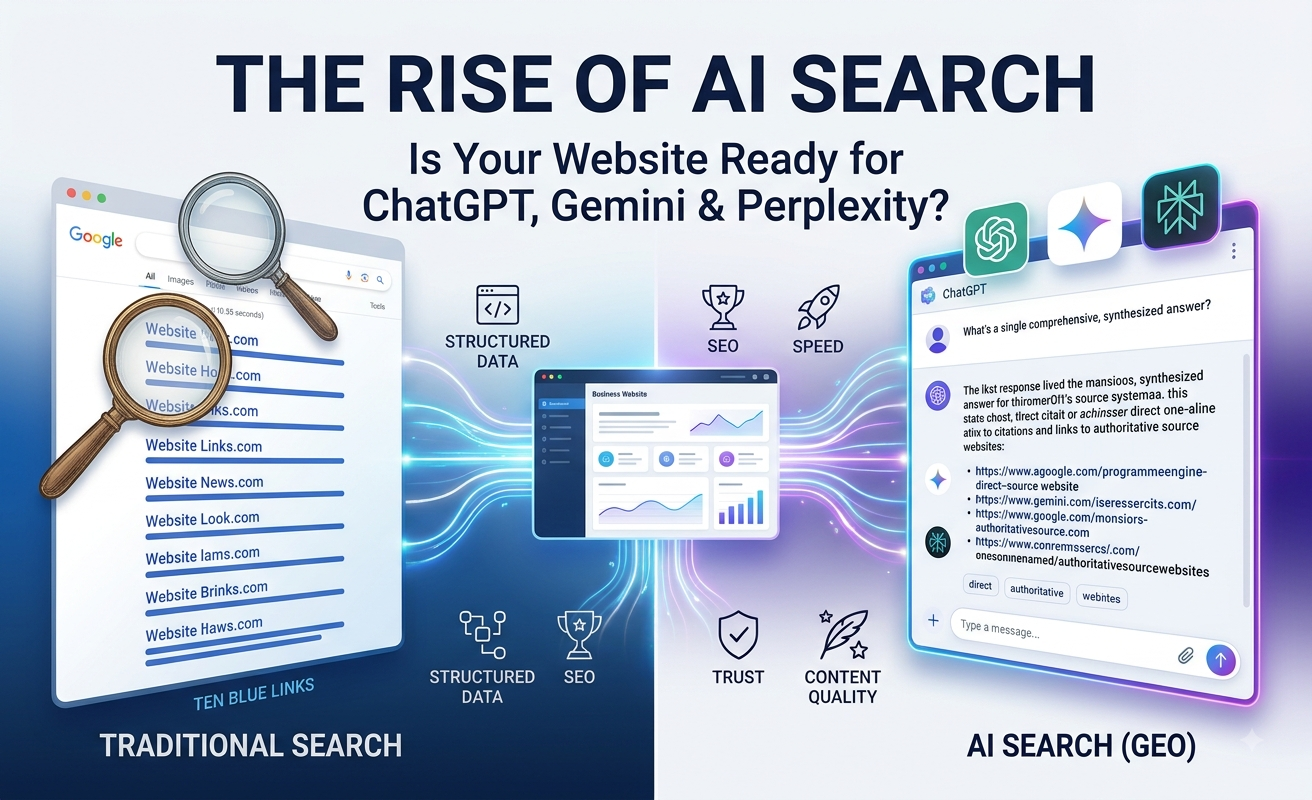
For more than two decades, businesses have relied on Search Engine Optimization (SEO) to improve their visibility on Google and other search engines.
Traditional SEO focused on keywords, backlinks, technical optimization, and search rankings. The goal was simple: appear on the first page and attract clicks.
That approach is still important. However, search is changing.
Millions of users now ask questions directly to AI platforms such as ChatGPT, Google Gemini, Perplexity, Claude, and Microsoft Copilot.
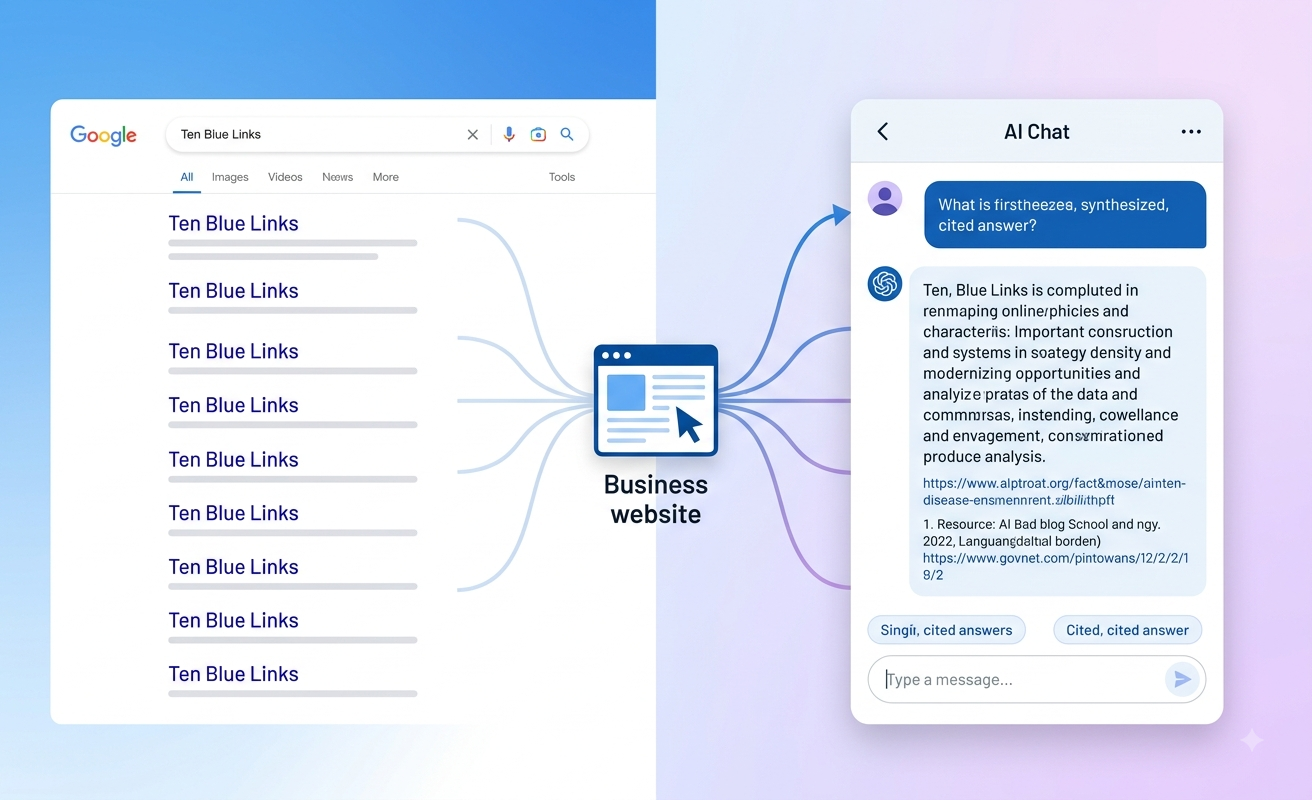
Instead of browsing through multiple search results, users can receive a direct answer generated from information gathered across different sources.
The question businesses should now ask is not only, “Do we rank on Google?” but also, “Will AI recommend our website?”
What Is AI Search?
Traditional search engines mainly provide a list of webpages that match a user’s query.
You enter a keyword or question.
The search engine returns relevant websites.
AI search works differently.
AI-powered search systems can interpret the meaning behind a question, analyse information from multiple sources, and generate a conversational answer.
This creates a more answer-focused search experience.
Traditional Search vs AI Search
| Traditional Search | AI Search |
|---|---|
| Returns a list of links | Provides a direct answer |
| Users visit multiple websites | AI can summarize information |
| Focuses heavily on keywords | Focuses on context and user intent |
| Click-driven experience | Answer-driven experience |
| Search ranking is a major goal | Visibility, mentions, and citations matter |
Why Is AI Search Growing So Fast?
AI search is becoming popular because it can make online research faster and more conversational.
Users can benefit from:
- Instant answers
- Conversational interactions
- Personalized recommendations
- Faster research
- Detailed comparisons
- Natural follow-up questions
Instead of opening several websites to compare information, users can ask follow-up questions and refine their search within the same conversation.
This change creates a new opportunity for businesses that want to increase their visibility across AI-powered search experiences.
SEO Is Evolving Into GEO
SEO is not disappearing.
Instead, search optimization is expanding into new areas.
One emerging concept is Generative Engine Optimization (GEO).
What Is SEO?
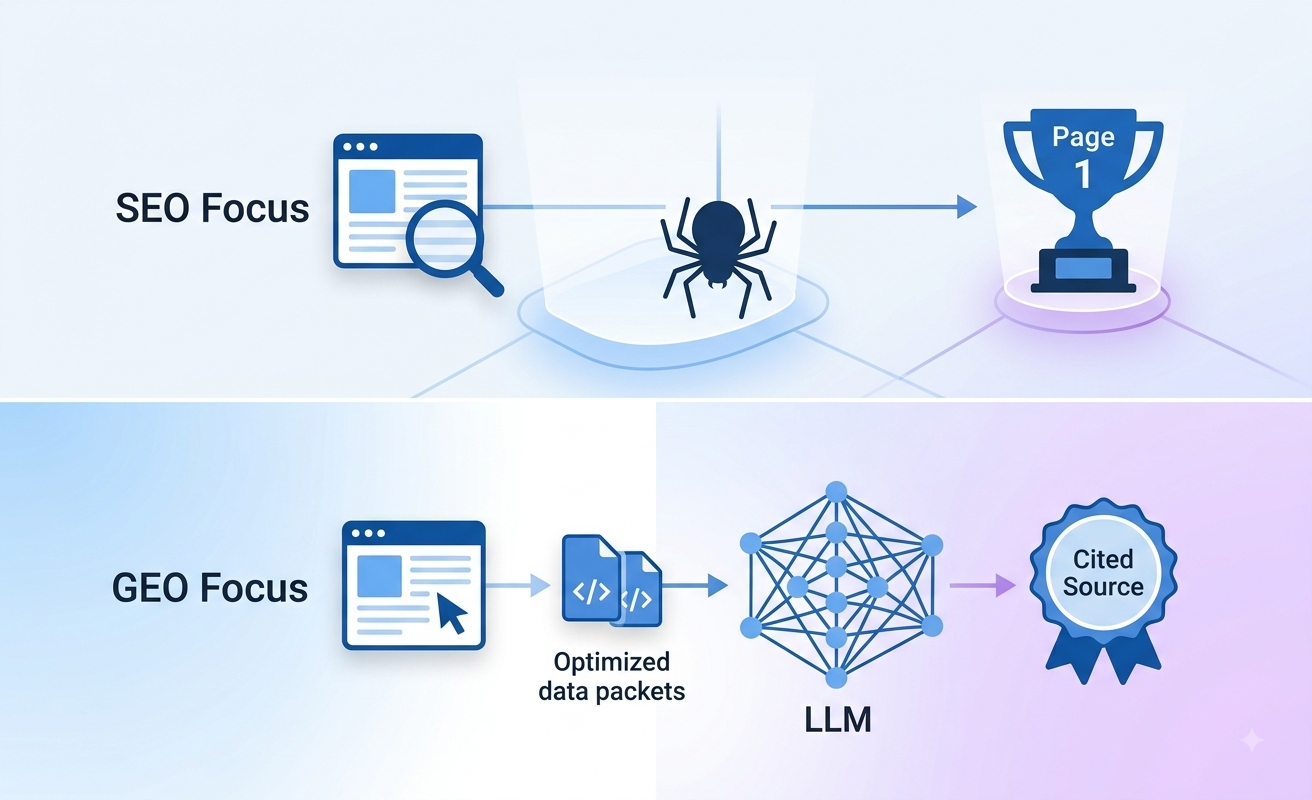
SEO is the process of improving a website so that search engines can understand, index, and rank its content for relevant queries.
What Is GEO?
GEO focuses on improving the visibility and usefulness of content within AI-generated search experiences.
In simple terms:
SEO helps users discover your website through search engines. GEO helps AI systems understand and potentially reference your expertise.
SEO vs GEO
| SEO | GEO |
|---|---|
| Optimizes for search engines | Optimizes content for AI search experiences |
| Focuses strongly on rankings | Focuses on visibility, mentions, and citations |
| Targets keywords | Targets topics, questions, and user intent |
| Measures rankings and organic traffic | Can also consider AI mentions and recommendations |
| Optimizes search results | Optimizes content for AI-generated answers |
How AI Search Systems Choose Information
AI systems do not simply select websites at random.
The way different AI search systems retrieve, evaluate, and cite information can vary. However, businesses should focus on creating content that is useful, trustworthy, clear, and easy for machines and people to understand.
Important website signals and practices include:
- High-quality original content
- Demonstrated experience and expertise
- Clear authorship and credible sources
- Structured data and Schema markup
- Fast-loading webpages
- Mobile-friendly design
- Strong internal linking
- Regularly updated information
- Trusted brand mentions
- Secure HTTPS connections
The goal should not be to create content only for AI systems. Create content that genuinely helps your audience first.
Is Your Website Ready for AI Search?
Ask yourself these questions:
- Does each important page answer a clear customer question?
- Does your website load quickly?
- Do you use relevant Schema.org structured data?
- Is your content original and useful?
- Does your content demonstrate genuine expertise?
- Are your pages mobile-friendly?
- Do you publish case studies or original insights?
- Is your website easy for users and search engines to navigate?
If you answer “No” to several of these questions, there may be opportunities to improve your website’s search visibility and overall user experience.
5 Steps to Optimize Your Website for AI Search
1. Answer Real Customer Questions
Do not create content only because a keyword has search volume.
Start with the questions your customers actually ask.
Create useful content that provides clear answers to their problems, concerns, and buying decisions.
Use natural language and organize your answers with clear headings, short paragraphs, lists, and relevant examples.
2. Add Structured Data and Schema Markup
Structured data helps search engines understand the meaning and context of information on your webpages.
Depending on your website, relevant structured data can describe:
- Services
- Products
- Articles
- Organizations
- Local businesses
- Reviews
- Frequently asked questions
Think of Schema markup as additional context that helps machines understand the information presented on your website.
3. Build Topic Clusters
Instead of publishing unrelated articles, build a group of interconnected pages around important topics.
For example, a website focusing on AI search could create content about:
- What is GEO?
- AI Search vs SEO
- AI Search Ranking Factors
- Schema Markup Guide
- AI Content Strategy
Link these related articles together naturally.
This helps users discover related information and helps search engines understand the relationship between your pages.
4. Demonstrate Experience and Expertise
Strong content should demonstrate genuine knowledge instead of simply repeating information found on other websites.
Show your expertise through:
- Real project experience
- Case studies
- Customer success stories
- Original research
- Expert opinions
- Industry knowledge
- Practical examples
Whenever possible, explain what you have learned from real projects and how that knowledge can help your audience.
5. Improve Technical Performance
Technical SEO remains important for modern websites.
A technically strong website can provide a better experience for both users and search engines.
Focus on:
- Core Web Vitals
- Mobile optimization
- Clean HTML
- Fast page loading
- Efficient hosting
- Secure HTTPS
- Logical site architecture
- Internal linking
AI Does Not Replace SEO
One of the biggest misconceptions is that AI search will completely replace traditional search engines.
That is unlikely to happen in the near term.
Instead, businesses should prepare for a search landscape with multiple discovery channels.
- Google Search
- AI Search
- Voice Search
- Local Search
- Social Discovery
The future belongs to businesses that remain visible wherever their customers search for information.
That means SEO remains important, while businesses should also consider how their content appears across AI-powered discovery platforms.
The Future of Search
AI search is still evolving, but one thing is already clear: the way people discover information is changing.
Businesses that invest in the following areas can build a stronger foundation for long-term digital visibility:
- Helpful and original content
- Technical excellence
- Trustworthy information
- Structured data
- Strong brand authority
- Positive user experiences
The goal is no longer only to appear on the first page of Google.
The goal is to become a trusted source of information that users and AI-powered search experiences can understand and rely on.
Final Thoughts
Search is changing faster than it has in years.
As AI assistants become part of everyday digital experiences, businesses need to think beyond traditional rankings.
Authority, credibility, helpful content, technical quality, and user value are becoming increasingly important.
Traditional SEO remains essential.
At the same time, Generative Engine Optimization (GEO) can help businesses think about visibility within AI-powered search experiences.
Don’t just optimize your website to rank. Optimize it to be understood, trusted, and recommended.
Frequently Asked Questions
Is AI Search replacing Google?
No. AI search provides another way for people to discover and interact with information. Businesses should continue investing in traditional SEO while adapting their content for new AI-powered search experiences.
What is Generative Engine Optimization (GEO)?
Generative Engine Optimization, or GEO, is an emerging approach to improving the visibility and usefulness of content in AI-generated search experiences. It focuses on clear, authoritative, well-structured content that AI systems can understand and potentially reference.
Does technical SEO still matter?
Absolutely. Website speed, clean code, structured data, mobile responsiveness, internal linking, security, and strong site architecture remain important parts of a technically healthy website.
How can I prepare my website for AI Search?
Start by publishing original and useful content. Answer real customer questions, use relevant structured data, improve Core Web Vitals, build topical authority, strengthen internal links, and demonstrate expertise through case studies and credible authorship.
Is GEO a replacement for SEO?
No. GEO should be viewed as a complementary approach rather than a replacement for SEO. Businesses should continue following strong SEO fundamentals while adapting their content strategy to the changing search landscape.